
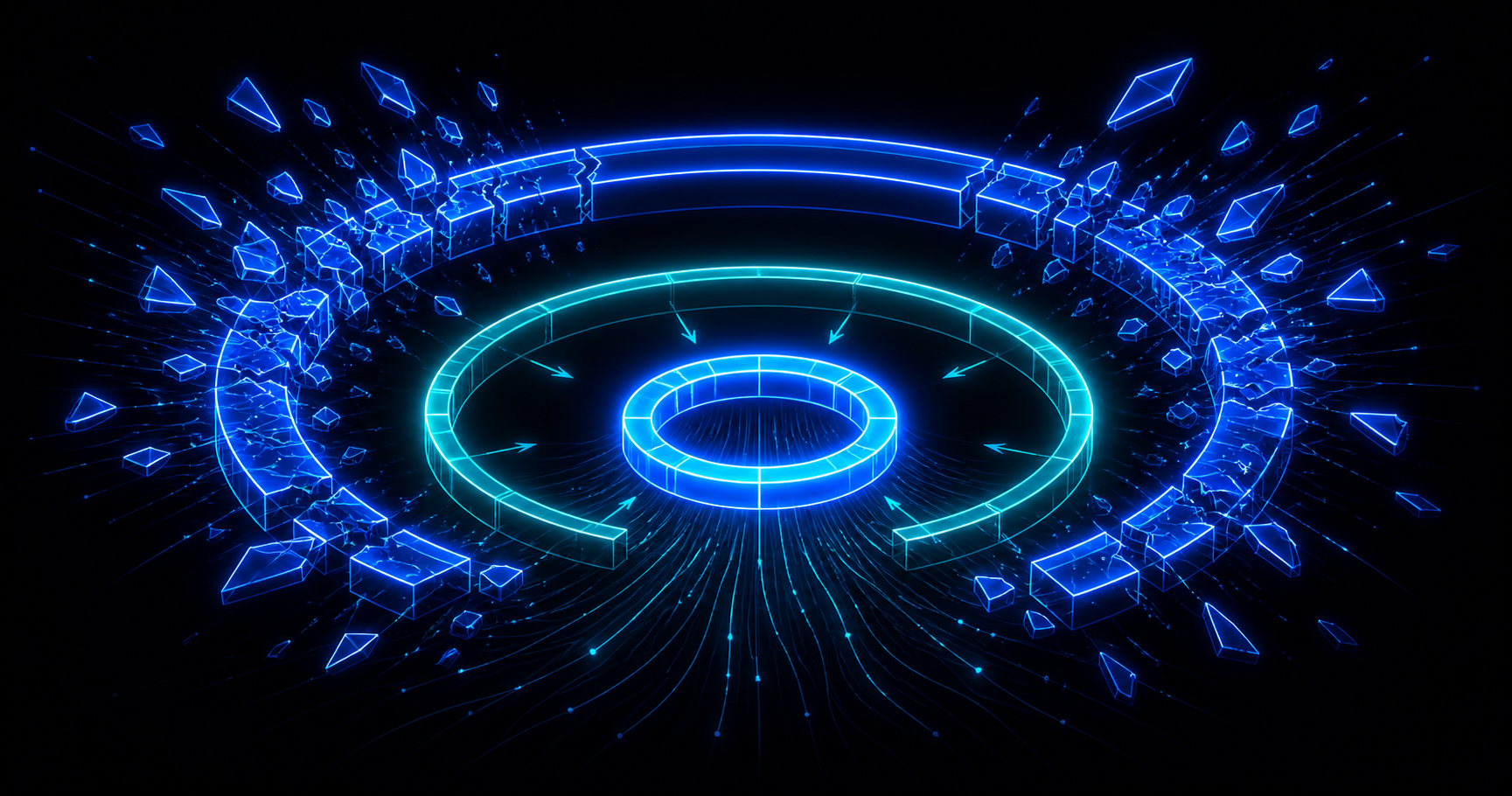
Infrastructure Survives the Bubble
Three AI bubbles: wrapper companies pop, foundation models consolidate, governance infrastructure survives. Like fiber optic after the dotcom bust.
 Michael Gearhardt
Infrastructure Survives the Bubble
Everyone's watching the wrong consolidation.
The AI industry is bleeding. Layoffs at wrapper companies. Foundation models burning cash faster than they can raise it. Analysts calling tops on everything from chatbots to code assistants.
And most observers are asking the wrong question: "When does the AI bubble pop?"
The answer is: it doesn't. Because there isn't one bubble. There are three.
The Three Bubbles
Bubble One: Wrapper Companies
These are the startups that put a nice interface on someone else's model. ChatGPT plugins. Copilot extensions. "GPT for X" products that could be replicated in a weekend by a motivated developer with API access.
Timeline to pop: 18 months or less. Many are already gone.
Bubble Two: Foundation Models
OpenAI. Anthropic. The companies training the models themselves. They've raised billions. Their burn rates are staggering. Their moats are real but expensive to maintain.
Timeline: Consolidation over 2-4 years. Not all will survive the journey to profitability. The question isn't whether they'll consolidate-it's who remains standing.
Bubble Three: Infrastructure
The layer that doesn't depend on which model wins. The governance, orchestration, and deployment infrastructure that any AI-powered organization will need-regardless of whether they're using Claude, GPT, or something that doesn't exist yet.
Timeline: Survives long-term. Retains value regardless of which applications succeed above it.
The Fiber Optic Lesson
Most people forget this about the dot-com crash:
The fiber optic cables laid during that bubble weren't wasted. They enabled YouTube. They enabled Netflix. They enabled cloud computing. The companies that laid those cables mostly went bankrupt-but the infrastructure remained, and it powered everything that came next.
The same pattern is playing out now.
The wrapper companies will largely disappear. Some foundation models will consolidate or fail. But the infrastructure layer-the systems that govern how AI integrates with enterprise operations-that layer survives.
Not because it's immune to market forces. Because it's useful regardless of which specific AI wins.
The governance layer doesn't care if you're using Claude or GPT-5 or a model that hasn't been invented yet. It cares about: Who approved this action? What constraints apply? Can we roll it back? Is this auditable?
Those questions don't change when the model changes.
The Two Consolidations
The industry is about to go through two waves of consolidation. Most people are focused on the first one. The smart money is positioning for the second.
Consolidation #1: Who Wins Code-Writing?
This is the current bloodbath. Copilot vs. Cursor vs. Claude Code vs. the next entrant. Everyone's fighting over who gets to be the developer's primary AI interface.
This battle is loud. It gets all the attention. It will produce a winner-or a small set of winners-within the next 12-24 months.
Consolidation #2: How Do Transformed Teams Deploy Safely?
This is the question nobody's asking yet. But they will.
When the dust settles on Consolidation #1, every surviving organization will have AI deeply embedded in their development workflow. Code will be written faster. Changes will come faster. The blast radius of every deployment will be larger.
And then they'll need to answer: How do we govern this?
How do we ensure that AI-assisted changes don't break production? How do we maintain audit trails when the AI is proposing hundreds of changes a day? How do we let junior developers contribute without giving them the keys to destroy everything?
The platform answers these questions.
Everyone's watching Consolidation #1. We're building for Consolidation #2.
The Value Stack
Not all layers of the AI stack carry the same risk-or the same value.
| Layer | Examples | Risk | Value Capture |
|---|---|---|---|
| Wrapper | ChatGPT plugins, Copilot extensions | Highest | Lowest |
| Application | Cursor, Claude Code, dedicated AI tools | Medium | Medium |
| Execution | Platform layer, deployment infrastructure | Lowest | Highest |
The further down the stack you go, the more durable your position. Wrappers are trivially replaceable. Applications are somewhat defensible but still vulnerable to model shifts. Execution infrastructure-the layer that governs how AI operates within an organization-that's the layer that compounds.
Why? Because once an organization's requirements are embedded in their platform, switching costs become real. Not because of vendor lock-in. Because their rules are embedded there. Their approval workflows. Their audit requirements. Their safety constraints.
That's infrastructure. It survives the bubble.
The Position
We're not betting on AI. We're building what AI needs.
The question for VCs, CTOs, and board members isn't "which AI will win?" It's "what infrastructure will be required regardless of which AI wins?"
The answer: governance. Orchestration. The ability to let AI propose while humans (or policies) decide. The ability to audit every action. The ability to roll back when something goes wrong.
That's not a bet on Claude. That's not a bet on OpenAI. That's a bet on the pattern itself.
The companies that survive the consolidation won't be the ones who picked the right model. They'll be the ones who built infrastructure that works with any model.
The Invitation
The fiber optic companies of the dot-com era didn't know they were building YouTube's backbone. They just knew that bandwidth would matter.
We know that governance will matter.
When the AI bubble discourse fades-when the wrapper companies are absorbed and the foundation model wars have winners-there will still be organizations trying to figure out how to deploy AI safely at scale.
They'll need infrastructure. Not another wrapper. Not another model. Infrastructure.
The question isn't "which AI wins?" The question is "what infrastructure remains when the dust settles?"
Governance is that infrastructure.
Read the manifesto: The Governance Layer Nobody's Building →
Two commands. Your vault loads in under 3 seconds.
deno run -A "https://www.fathym.com/fai/install.deno"New posts on AI workbenches, developer ownership, and compounding intelligence — when they're ready, not on a schedule.